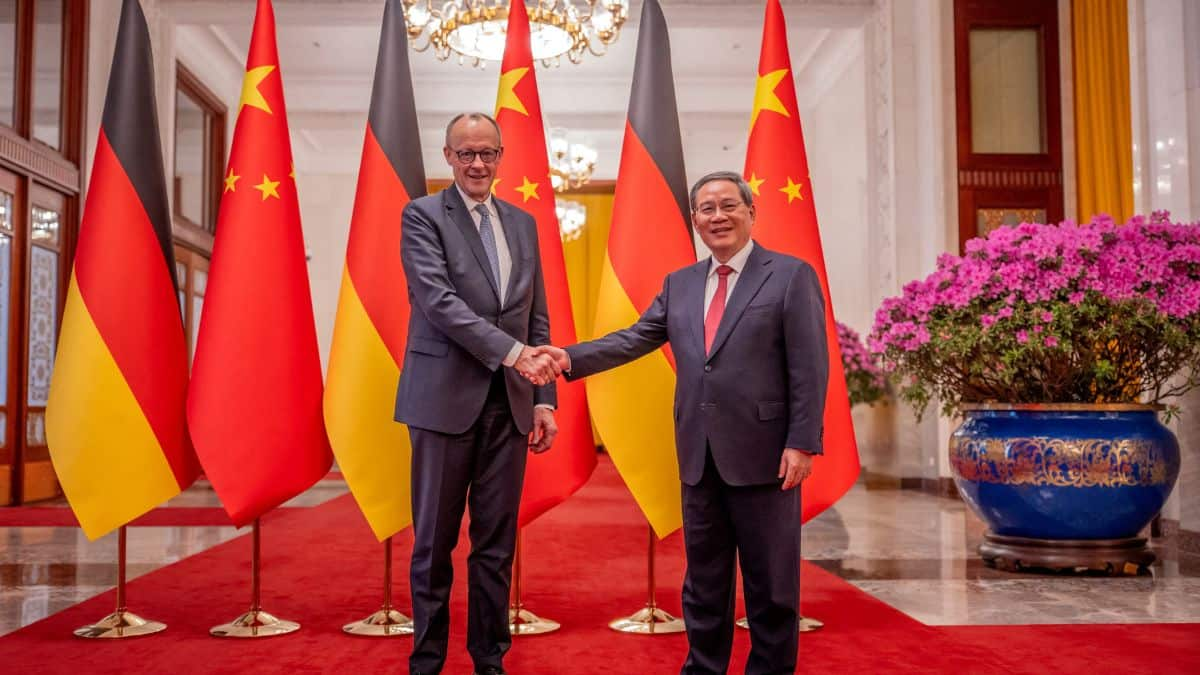
The arrival of Chancellor Friedrich Merz in Beijing signals a structural shift from the reactive "de-risking" posture of the previous administration toward a proactive model of Functional Reciprocity. While his predecessors often prioritized short-term export stability or ideological distancing, the current administration is operating under a strategy designed to address the widening asymmetry in market access and industrial subsidies. This transition marks the end of the "Wandel durch Handel" (change through trade) era, replacing it with a clinical assessment of economic interdependencies where German industrial survival is weighted against the systemic risks of technology transfer.
The Triad of German-Chinese Strategic Friction
The current diplomatic mission is built upon three non-negotiable pillars of friction that dictate the success or failure of German-Chinese cooperation. These are not merely points of debate; they are the fundamental variables in Germany's new foreign policy cost function.
1. The Asymmetry of Market Penetration
For decades, German automotive and engineering firms enjoyed high-margin growth in China under a framework of joint ventures. Today, that model has reached its exhaustion point. The "fair cooperation" mentioned by the Chancellor refers to a specific structural deficit: German firms face increasingly complex "Behind-the-Border" barriers in China—such as local content requirements and opaque licensing—while Chinese state-backed entities enjoy relatively open access to the European Single Market.
The Merz Doctrine suggests that future cooperation is contingent on a Ratio of Access. If the regulatory burden for a German chemical firm in Shanghai remains significantly higher than that of a Chinese EV manufacturer in Lower Saxony, the German government will likely utilize the EU’s anti-subsidy instruments as a balancing mechanism rather than a punitive one.
2. The Subsidy-Driven Capacity Surplus
A primary driver of the current tension is the "Supply-Side Divergence." China’s industrial policy has funneled massive capital into green technologies, resulting in production capacities that far exceed domestic demand. This surplus is not an accident but a strategic feature intended to capture global market share through price deflation.
From a consultant’s perspective, this creates a Negative Externality for German manufacturers who cannot compete with state-subsidized pricing. The Chancellor’s objective in Beijing is to define the boundaries of "overcapacity." Cooperation is no longer "improved" if it results in the hollowing out of the German Mittelstand (small-to-medium enterprises). The strategic move here is to negotiate a "Managed Trade" framework where volume caps or price floors might prevent a complete collapse of European domestic production in the solar and wind sectors.
3. Dual-Use Technology and Security Perimetering
The geopolitical context of the Ukraine conflict has transformed trade from a purely economic activity into a security variable. The "improved cooperation" sought by Merz is bifurcated:
- The Green Lane: Climate tech, healthcare, and basic consumer goods where collaboration is encouraged.
- The Red Lane: Semiconductors, AI, and telecommunications infrastructure where German policy is aligning closer to the Washington-Brussels axis of export controls.
The Cost Function of German Industrial Dependency
To understand the Chancellor's leverage, one must quantify the cost of a "Hard Decoupling" versus "Strategic Alignment." Germany’s reliance on China is concentrated in specific nodes of the value chain, particularly in rare earth processing and lithium-ion battery components.
The risk is not a total loss of trade, but a Supply Chain Chokehold. If China were to restrict exports of critical minerals, the German automotive sector would face an estimated 15-25% increase in production costs within six months. Conversely, China’s reliance on German high-end precision machinery and chemical catalysts remains a significant point of leverage. Merz is utilizing this "Interdependence Equilibrium" to argue that a trade war serves neither party. However, his rhetoric suggests that Germany is now willing to pay the "Autonomy Premium"—the higher cost of sourcing from elsewhere—if reciprocity is not achieved.
The Mechanism of Competitive Neutrality
The Chancellor’s team is pushing for Competitive Neutrality, a framework where state-owned enterprises (SOEs) are forced to operate under the same fiscal constraints as private German firms. This involves:
- Transparency in Financing: Demanding clarity on low-interest loans provided by Chinese state banks.
- Intellectual Property Enforcement: Shifting from verbal agreements to enforceable arbitration mechanisms that do not favor the domestic player by default.
- Public Procurement Equality: Ensuring German firms can bid for Chinese infrastructure projects with the same ease that Chinese firms bid for European energy contracts.
The Shift from Multilateralism to Minilateralism
The logic behind this visit reveals a move away from broad, ineffective EU-China summits toward Minilateral Agreements. Merz is focusing on specific industrial corridors. Instead of a "Grand Bargain," the strategy involves "Micro-Reciprocity." For every sector where China eases restrictions, Germany offers a corresponding "Value-Add" in terms of technical standards or joint R&D in non-sensitive areas.
This creates a Staggered Integration model. If the automotive sector sees improved fairness, then the aerospace or biotech sectors follow. This piecemeal approach prevents the "All-or-Nothing" traps that stalled previous trade agreements. It also allows the German government to test the sincerity of Chinese "Open Door" rhetoric in real-time.
Strategic Constraints and Execution Risks
No strategy is without a failure state. The Chancellor’s approach faces two primary bottlenecks:
- The European Cohesion Deficit: While Merz speaks for Germany, trade policy is an EU competence. If France or Italy pursue divergent bilateral deals with Beijing, the German leverage of "Reciprocity" is diluted. China has historically used a "Divide and Rule" tactic within Europe, offering preferential deals to specific nations to prevent a unified bloc.
- The Domestic Industrial Lobby: Large DAX-listed companies (Volkswagen, BASF, Siemens) have massive capital expenditures sunk into the Chinese market. These firms often act as a secondary diplomatic channel, sometimes undermining the government's "Tough Reciprocity" stance to protect their quarterly dividends. Merz must manage the internal tension between national security interests and the immediate profitability of Germany's industrial giants.
The Calculus of "Fairness" in High-Tech Manufacturing
When Merz discusses "fairness," he is referencing the Total Cost of Innovation. In a standard market economy, R&D is funded by private capital or competitive grants. In the Chinese model, R&D is often socialized through the state. This creates a fundamental imbalance in the "Global Innovation Race."
Germany's response, as signaled during this trip, is the implementation of Dynamic Tariffs. These are not static taxes but rather adjustments based on the "Subsidy Delta"—the difference between the market cost of production and the state-supported price. This provides a quantifiable mechanism to enforce the fairness the Chancellor is demanding.
The Logical Forecast for 2026 and Beyond
The trajectory of German-Chinese relations under the Merz administration will not return to the frictionless growth of the 2010s. Instead, we are entering a phase of Contractual Realism.
The strategic play for German firms moving forward is the "China + 1" strategy, but with a twist. It is no longer just about diversifying supply chains to Southeast Asia or India; it is about "In-Country, For-Country" localization. German firms will likely continue to invest in China, but those operations will become increasingly decoupled from their European headquarters to mitigate the risk of cross-border data or technology seizures.
The outcome of the Beijing meetings will be measured by a single metric: the volume of German SME participation in the Chinese market over the next 24 months. If the barriers for smaller firms do not drop, the German government will be forced to accelerate the "Relocation Incentives" program, effectively subsidizing the exit of key industries from the Chinese ecosystem.
The Chancellor’s visit is the final attempt to stabilize the relationship through structural logic before the costs of interdependence become politically and economically unbearable. The move is to shift the conversation from "Trade Volume" to "Value-Chain Integrity." If Beijing accepts this framework, a new era of stable, albeit cooler, cooperation begins. If they reject it, Germany has already prepared the legislative groundwork for a rapid pivot toward an "Atlantic-First" economic policy.