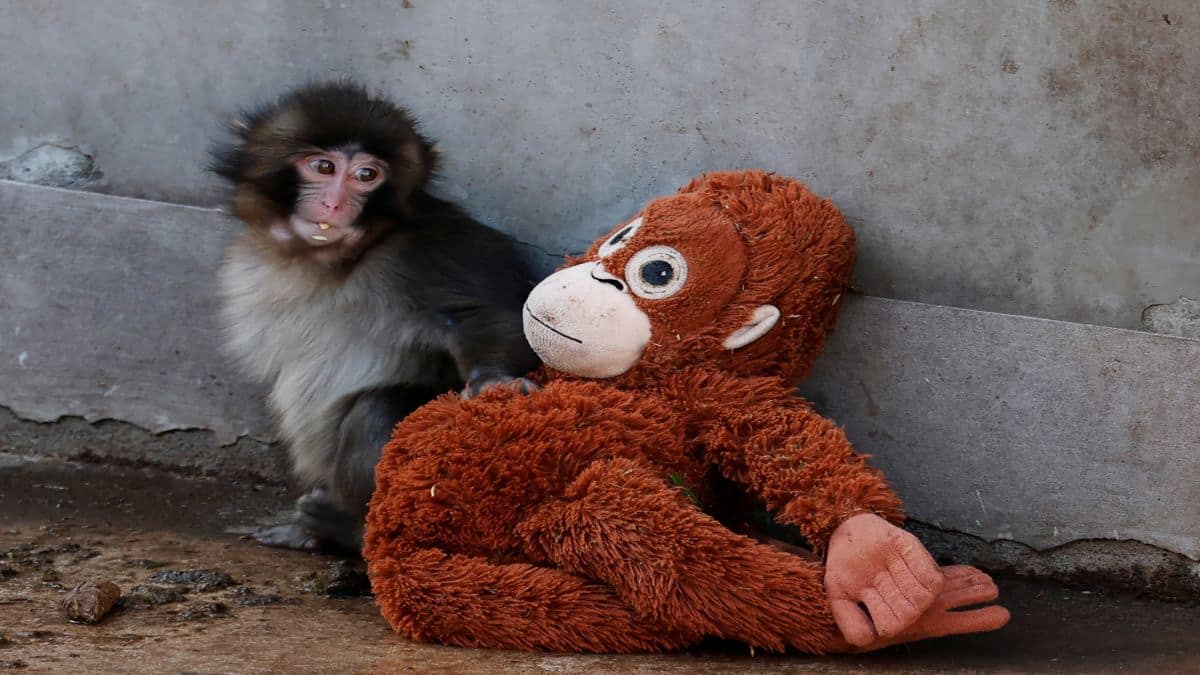
The global obsession with Punch, the Japanese macaque, is not a product of organic charm or "internet magic." It is a highly efficient demonstration of Cross-Platform Cognitive Priming and Low-Friction Intellectual Property (IP) Scaling. While casual observers credit the monkey’s expressive face or fashionable attire, the underlying economic engine relies on a specific sequence: the compression of high-context physical humor into low-barrier digital loops, followed by the rapid deployment of high-margin physical goods.
The Three Pillars of the Punch Phenomenon
The success of the Punch brand is built upon a deliberate intersection of biological empathy, algorithmic distribution, and scarcity-driven retail.
1. Neuro-Visual Salience and the Neoteny Loop
Human facial recognition systems are evolutionarily tuned to detect emotion in primates. Punch’s "performances"—often involving human-like frustration, boredom, or excitement—trigger a high-arousal response in the viewer. This is a biological exploit. By dressing the macaque in streetwear, the handlers create Anthropomorphic Dissonance. The brain attempts to resolve the conflict between "wild animal" and "fashion-conscious human," leading to extended dwell times on short-form video platforms. These milliseconds of extra attention signal "high quality" to recommendation engines, creating a self-reinforcing viral loop.
2. The Velocity of Zero-Context Content
Unlike traditional celebrities or fictional characters, Punch requires zero cultural context to understand. A viewer in Tokyo, New York, or São Paulo experiences the same comedic payoff simultaneously. This removes the "Translation Tax" that usually slows down global IP expansion. The content functions as a universal semiotic unit:
- Visual-Only Narrative: No dialogue means no language barrier.
- Platform Agnosticism: The content fits the aspect ratios and consumption habits of TikTok, Instagram Reels, and YouTube Shorts perfectly.
- Meme-Ready Format: The monkey’s reactions are modular. They can be detached from the original video and repurposed as digital stickers or reaction GIFs, further extending the brand’s reach without additional marketing spend.
3. Artificial Scarcity and the Collectible Tier
The transition from "viral video" to "sold-out toy" is a textbook execution of the Veblen Effect. By limiting the production of physical merchandise and utilizing "drop" culture—releasing items in small batches at specific times—the brand creates a secondary market. This transforms a simple plush toy into a speculative asset. When supply is intentionally kept below the equilibrium point of demand, the "buzz" is maintained not by the product’s utility, but by its unavailability.
Quantifying the Conversion Funnel
The conversion of a passive viewer into a paying customer for Punch merchandise follows a rigorous mathematical progression. We can define the Brand Conversion Efficiency (BCE) as the ratio of unique video views to physical unit sales.
$$BCE = \frac{U_{sales}}{V_{unique} \times \alpha}$$
Where $\alpha$ represents the platform friction coefficient. For Punch, $\alpha$ is remarkably low because the transition from the video feed to the digital storefront is often integrated (e.g., TikTok Shop or Instagram Checkout).
The Bottleneck of Physicality
The primary constraint on the Punch business model is the scalability of the central asset: a living animal. Unlike a digital avatar (like a VTuber) or a CGI character (like Mickey Mouse), a biological asset has physical limits.
- Content Production Ceiling: An animal can only "work" or be filmed for a limited number of hours per day. This creates a hard cap on the volume of original raw footage.
- Ethical Scrutiny and Regulatory Risk: As the brand scales, it encounters increasing friction from animal welfare standards and international import/export laws regarding primate-related imagery or products. This creates a "Reputational Liability" that digital-first IP does not have to manage.
The Revenue Architecture of Viral Mascotry
The monetization strategy deviates from the traditional "Entertainment First" model. In the old model, a studio would produce a movie to sell toys. In the Punch model, the "content" is merely a perpetual advertisement for a high-frequency retail engine.
High-Margin Licensing
Instead of manufacturing everything in-house, the strategy involves licensing the image of Punch to established third-party brands. This shifts the operational risk—inventory, shipping, and returns—onto the licensee while the IP owner collects a risk-free royalty (typically 8% to 15% of gross sales).
The Feedback Loop of User-Generated Content (UGC)
The brand does not need to pay for advertising because the audience performs the marketing. When a user buys a Punch toy, they film themselves with it. This creates a Tertiary Distribution Layer:
- Primary: Official Punch accounts post content.
- Secondary: Repost accounts and meme aggregators spread the content.
- Tertiary: Consumers post "unboxing" or "lifestyle" content with the physical product.
This third layer is the most valuable because it serves as social proof, lowering the "Trust Barrier" for new potential customers.
Strategic Constraints and Market Saturation
The "Banana Craze" faces the inevitable reality of Trend Decay. In the digital economy, the half-life of a viral meme is shrinking. To survive beyond the initial 18-month hype cycle, the brand must pivot from "Viral Animal" to "Lifestyle Symbol."
The current trajectory suggests a move toward Abstracted IP. This involves moving away from photos of the actual monkey and toward stylized, graphic representations (logos, silhouettes, or 3D animations). By abstracting the asset, the owners can decouple the brand from the biological limitations and risks of a live animal.
The Risk of Counterfeit Proliferation
The simplicity of the Punch aesthetic makes it vulnerable to unauthorized reproduction. In the absence of a strong legal moat or complex technical features in the toys, the market can be flooded with "knock-offs" that erode the brand's perceived value. The counter-strategy here is not just legal action, but the implementation of Authentication Markers (e.g., NFC chips in toys or limited-edition blockchain-verified certificates).
The Portfolio Strategy for Digital IP Owners
To maximize the longevity of the Punch brand and similar viral assets, the following operational maneuvers are required:
- De-couple the Asset: Transition the visual identity from a specific living animal to a stylized character brand. This allows for 24/7 content generation via animation and removes the ethical and biological bottlenecks.
- Diversify the Revenue Mix: Shift from 90% physical goods to a balance of 50% physical and 50% digital/licensing revenue. This includes high-margin digital products like in-game skins, messaging app stickers, and virtual "pets" in the metaverse.
- Aggressive Platform Diversification: Reduce dependency on a single algorithm (e.g., TikTok) by building direct-to-consumer channels, such as a dedicated app or an email-gated "exclusive drop" list. This protects the brand's reach if a platform changes its recommendation logic or bans specific types of animal content.
- Localize the Physical Supply Chain: To maintain the "Sold Out" status without losing sales to long shipping times, regional distribution hubs must be established. The goal is to minimize the time between the "impulse trigger" (seeing the video) and the "possession event" (receiving the toy).
The Punch phenomenon is a blueprint for the future of decentralized celebrity. It proves that with the right combination of biological triggers and algorithmic alignment, a niche cultural artifact from Japan can dominate the global attention economy in under twelve months. The durability of the brand now depends entirely on its ability to transition from a fleeting visual gag into a robust, abstracted ecosystem of commerce and identity.