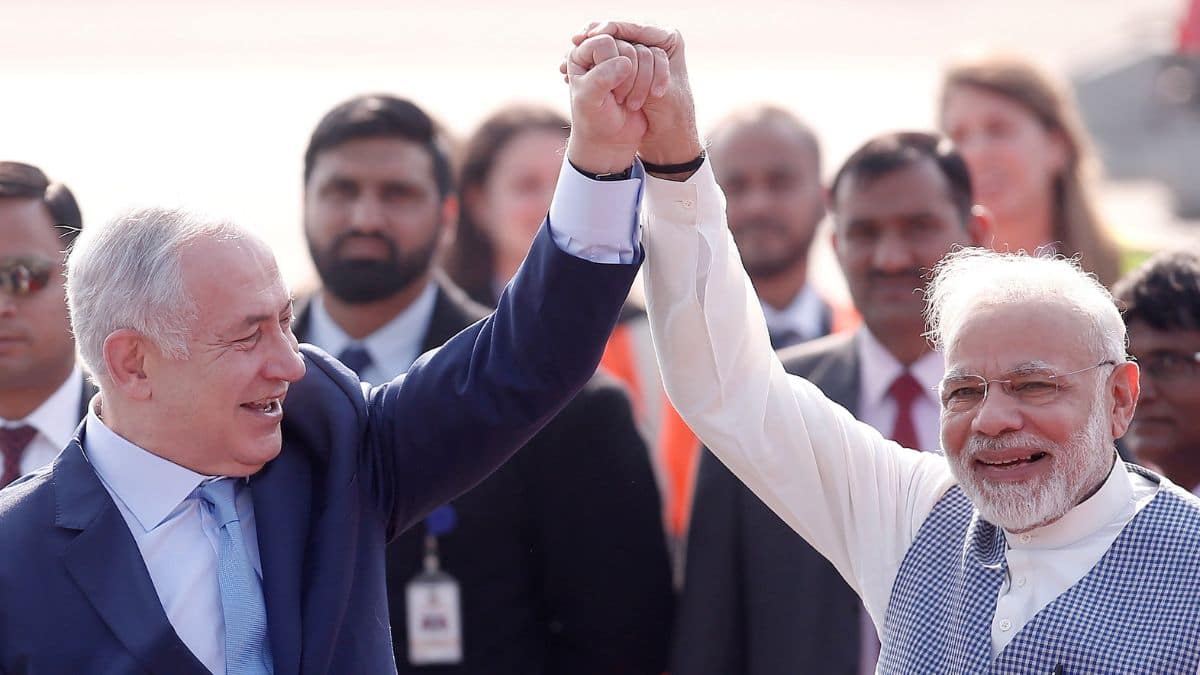
The shift is no longer subtle. In late February 2026, the elevation of the India-Israel relationship to a Special Strategic Partnership for Peace, Innovation, and Prosperity signaled the end of New Delhi’s decades-long era of cautious "balancing." For the first time, the ideological ghost of non-alignment has been replaced by a cold, transactional, and high-tech embrace that prioritizes domestic security and economic growth over historical third-world solidarity.
This isn't just about diplomacy; it is about survival in a fragmented global order. By formalizing this tier of engagement—the highest in India’s diplomatic lexicon—Prime Minister Narendra Modi and Benjamin Netanyahu have moved beyond the "buyer-seller" dynamic. They are now building a closed-loop ecosystem of defense, surveillance, and food security that operates independently of traditional Western or Arab pressures.
The Iron Beam and the New Defense Reality
For years, the cornerstone of this bond was the purchase of hardware: Phalcon AWACS, Heron drones, and Barak-8 missiles. However, the 2026 summit shifted the focus to co-production and technology transfer. The most significant development is the quiet integration of Israel’s Iron Beam technology into the Indian defense grid.
Unlike the Iron Dome, which uses expensive interceptor missiles, the Iron Beam uses a 100kW high-energy laser to neutralize rockets and drones at a cost of roughly $2 per shot.
- The Strategic Asset: India faces an increasing threat from low-cost drone swarms on its northern and western borders.
- The Collaboration: The partnership now includes a roadmap for joint manufacturing of these laser systems under the "Make in India" initiative, involving domestic giants like Adani Defense and Tata Advanced Systems.
- The Catch: This technology is heavily intertwined with U.S. research. The "Special" nature of the 2026 partnership is essentially a bet that India can bypass traditional export controls by embedding itself directly into Israel’s R&D cycle.
Surveillance and the Cyber Centre of Excellence
The relationship has also entered the digital trenches. The establishment of the India-Israel Cyber Centre of Excellence in 2026 serves as a hub for "Security by Design" principles. While the public narrative focuses on protecting power grids and financial systems, the underlying reality is a shared doctrine on internal security.
India has faced intense scrutiny over the alleged use of Israeli spyware like Pegasus. Yet, instead of distancing itself, the 2026 agreements double down on Artificial Intelligence (AI) for "Horizon Scanning" and risk assessment. This mechanism uses AI tools to monitor geopolitical threats and, presumably, domestic stability. It is a symbiotic exchange: Israel provides the algorithmic logic and "battle-proven" code, while India provides the massive datasets required to train these systems at scale.
The Trade Paradox
Despite the soaring rhetoric, the raw economic data reveals a complex picture. Bilateral merchandise trade (excluding defense) took a hit in 2024 and 2025, dropping to approximately $3.6 billion from a 2023 peak of over $10 billion.
| Trade Factor | Status in 2026 |
|---|---|
| Bilateral Trade | Declining in volume, increasing in high-tech value. |
| Main Exports (India) | Refined petroleum, diamonds, and textiles. |
| Main Imports (Israel) | Integrated circuits, fertilizers, and defense tech. |
| Free Trade Agreement | Finalizing "Early Harvest" terms to slash tariffs on tech. |
The dip in volume is largely due to regional instability in the Middle East and disruptions in Red Sea shipping routes. To counter this, both nations are pushing the India-Middle East-Europe Economic Corridor (IMEC). This project is designed to bypass the volatile Suez Canal by linking Indian ports to the UAE, Saudi Arabia, and ultimately Israel’s Haifa Port, now controlled by an Adani-led consortium. This isn't just a trade route; it is a geopolitical bypass surgery intended to reduce dependence on states that remain critical of the India-Israel axis.
Labor as a Strategic Commodity
One of the most controversial yet practical outcomes of the recent summit is the expansion of labor mobility. With the conflict in Gaza leading to the suspension of Palestinian work permits, Israel faced a massive labor vacuum in its construction and caregiving sectors.
India has stepped in to fill this gap, agreeing to send up to 50,000 additional workers over the next five years. For New Delhi, this is a way to manage its domestic unemployment while securing foreign remittances. For Jerusalem, it is a way to insulate its economy from the political volatility of its borders. It turns the human element of the partnership into a strategic buffer.
The Agriculture Factor
While missiles and software dominate the headlines, the "Villages of Excellence" program is what touches the ground. India has expanded its goal from 43 to 100 Centres of Excellence in agriculture. These centers introduce Israeli drip irrigation and desalination techniques to Indian farmers.
The intent here is purely political. By improving the yields of millions of Indian farmers through Israeli technology, the government builds a domestic constituency that sees a direct, personal benefit from the alliance. It transforms a foreign policy choice into a local economic win, making the partnership harder for future administrations to reverse.
The Abandonment of De-hyphenation
For decades, India practiced "de-hyphenation"—treating its relations with Israel and Palestine as separate tracks. That mask has largely slipped. While India still officially supports a two-state solution and provides humanitarian aid to Gaza, its voting record at the UN has shifted toward abstentions on resolutions critical of Israel.
The 2026 summit proved that New Delhi has calculated the cost of Palestinian solidarity and found it less valuable than the technological and security dividends offered by Jerusalem. The "Special Strategic Partnership" is an acknowledgment that India is no longer seeking to be a moral arbiter of the Global South. Instead, it is acting as a major power that prioritizes a "technology-first" foreign policy.
The alliance is now anchored in the I2U2 (India, Israel, UAE, USA) framework, creating a new "West Asian Quad." This bloc focuses on food security, clean energy, and space, but its true purpose is to create a stable, pro-trade, pro-tech corridor that resists the influence of both Iran and China.
India’s path is clear. It has traded the ideological purity of the past for a seat at the table of 21st-century power, where the currency of friendship is measured in laser systems, semiconductor fabs, and deep-sea ports. The era of the "balancing act" is over; the era of the strategic embrace has begun.